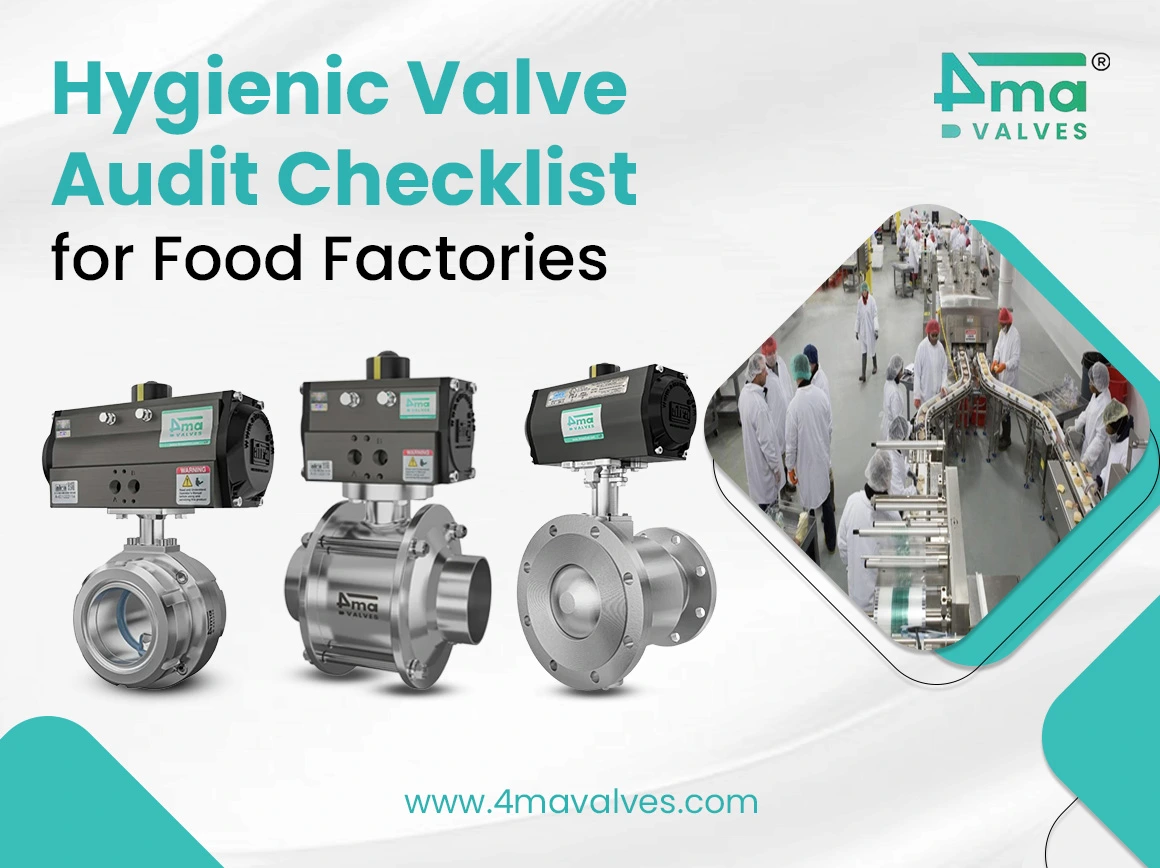
Running a food factory means operating under constant scrutiny from regulatory bodies, quality assurance teams, and increasingly, your own customers. Amid all the equipment that demands attention, hygienic valves are often underestimated in terms of their audit priority. Yet they sit at the intersection of product safety and process efficiency, controlling the flow of raw materials, process fluids, cleaning agents, and finished product every single day.
A missed crack in a seal, a corroded valve body, or an actuator that fails to fully close can compromise an entire production batch — or worse, result in a product recall. A structured valve audit is not a bureaucratic checkbox. It is a practical tool for protecting both product integrity and brand reputation.
This checklist is designed for food factory managers and maintenance engineers who need a reliable, repeatable framework for inspecting and evaluating their hygienic valve systems.
Why Hygienic Valve Audits Matter in Food Factories
Food safety regulations, whether under FDA 21 CFR, EHEDG guidelines, or 3-A Sanitary Standards, place clear obligations on manufacturers to ensure that all product-contact equipment is maintained in a clean, functional, and hygienic condition. Valves are product-contact components. They are not passive fittings.
In high-care environments like dairy processing, beverage filling, or pharmaceutical-grade food production, the condition of your hygienic valves directly affects your ability to pass audits, maintain certifications, and avoid contamination events. Yet valve inspection is often treated as a reactive task addressed only when something fails.
Proactive auditing changes that dynamic. It shifts valve management from breakdown maintenance to planned asset care, which reduces unplanned downtime, extends valve service life, and gives auditors the documented evidence they need to verify compliance.
Common Risks of Poor Valve Maintenance
Before walking through the checklist itself, it helps to understand what is actually at stake when valve maintenance slips.
- Microbiological contamination Dead legs, damaged seals, and valves that do not drain fully create pockets where bacteria — including Listeria and Salmonella — can colonise and survive CIP cycles.
- Cross-contamination between product lines When a valve fails to achieve a full seal, fluid from one circuit can migrate into another.
- Undetected leaks Undetected leaks lead to product loss, environmental hazards, and slip risks on factory floors.
- Non-compliance findings Non-compliance findings during third-party or customer audits can result in production holds, failed certifications, or contract terminations.
- Premature valve failure Seal degradation, incorrect cleaning chemistry, or pressure surges cause expensive emergency replacements and unplanned downtime.
None of these are low-probability events. They happen regularly in facilities where valve inspection is not structured or documented.
Hygienic Valve Audit Checklist
Use this checklist during scheduled maintenance shutdowns, pre-audit preparation, or as part of a rolling inspection programme across your production lines.
Material Inspection
- Confirm that all valve bodies and wetted components are manufactured from 316L stainless steel or an equivalent food-grade alloy as specified in your bill of materials.
- Check all surfaces for signs of pitting, corrosion, scoring, or discolouration — any of these indicate surface breakdown and potential harbourage sites.
- Inspect welds for crevices, porosity, or rough surfaces that could trap product or resist cleaning.
- Verify that surface finish meets the required Ra value (typically Ra ≤ 0.8 µm for food-grade surfaces) and has not been compromised by mechanical damage or chemical attack.
- Ensure non-wetted external components are also corrosion-resistant and suitable for washdown environments.
Seal and Gasket Condition
- Remove and visually inspect all seals, O-rings, and gaskets. Look for cracking, swelling, compression set, or surface degradation.
- Confirm that seal materials — typically EPDM, PTFE, or FKM — are appropriate for the process media and cleaning chemicals in use.
- Check that seals are correctly seated and not twisted, pinched, or displaced.
- Record seal age and replacement date against the manufacturer’s recommended replacement interval.
- Flag any seals showing discolouration or chemical attack, which may indicate incompatibility with CIP agents.
Leakage Inspection
- During operation, visually check all valve bodies, bonnets, and actuator connections for external leakage.
- Perform a pressure hold test on critical isolation valves to verify seat integrity — a valve that passes visual inspection may still have a compromised seat seal.
- Check valve stems and shaft entry points for process fluid weeping under pressure.
- Inspect downstream pipework for evidence of bypass leakage through a closed valve, particularly on shut-off and divert valves.
Cleaning Compatibility
- Review CIP parameters (chemical type, concentration, temperature, contact time, flow velocity) against the valve manufacturer’s stated cleaning compatibility.
- Confirm that sanitary valves in the system are fully drainable in their installed orientation — horizontal valve bodies should not trap fluid.
- Verify that CIP flow reaches all internal surfaces and that there are no dead legs longer than 1.5 times the pipe diameter.
- Check that spray devices or CIP return ports are not obstructed by debris or scale buildup.
- For butterfly valves and seat valves, confirm that the disc or plug fully opens during CIP to allow unrestricted cleaning flow.
Automation System Checks
- Test each actuated valve for full stroke operation — open, closed, and intermediate positions where applicable.
- Verify that position feedback sensors (limit switches, proximity sensors) are accurately indicating valve state to the control system.
- Check solenoid valves and pneumatic connections for air leaks, moisture ingress, or sluggish response.
- Inspect electrical connections on electric actuators for moisture damage, corrosion, or loose terminals.
- For modulating control valves, verify that positioner calibration is current and that the valve tracks its setpoint accurately across the full control range.
- Confirm that fail-safe functions work as designed — a spring-return actuator should return to its default position when air supply or power is removed.
Pressure and Temperature Checks
- Verify that each valve is rated for the maximum operating pressure and temperature it encounters in service, including CIP and SIP conditions.
- Check for evidence of pressure surge damage — deformed discs, cracked bodies, or displaced seals can all result from water hammer or rapid valve closure.
- Confirm that pressure relief devices upstream of sensitive valves are functional and correctly set.
- Where steam is used for SIP, verify that valve materials and seals are rated for the required steam temperature and cycle duration.
Compliance Verification
- Confirm that all valves carry the relevant certification markings — 3-A, EHEDG, or FDA compliance as required by your facility’s standards.
- Check that current technical datasheets and material certificates are on file and match the installed equipment.
- Review the valve maintenance history log for gaps in inspection records — undocumented valves are a red flag for external auditors.
- Verify that any valve modifications or replacements have been documented and approved through your management of change process.
- Ensure that spare parts used in repairs — particularly seals and gaskets — are OEM-approved or equivalent certified components, not generic substitutes.
Importance of Regular Valve Audits
A single audit is useful. A regular audit programme is what actually drives continuous improvement in process hygiene and equipment reliability.
Scheduled audits — whether monthly, quarterly, or annually depending on the criticality of the valve — create a documented asset history that supports trend analysis. If a particular seal type is failing consistently ahead of its replacement interval, that is a data point that leads to a specification change. If CIP effectiveness drops after a valve replacement, that triggers an investigation. Without the audit data, neither of those signals gets noticed until a contamination event makes the problem visible.
Regular valve inspection also builds confidence with customers and certification bodies. When a third-party auditor arrives and your team can produce inspection records, replacement logs, and material certificates for every valve on the line, that tells a story about how the facility is managed.
Tips for Improving Food Processing Safety Through Valve Management
A few practical recommendations that go beyond the checklist:
- Standardise your valve specification wherever possible. A facility running three different seal materials across similar process lines introduces unnecessary complexity and risk. Rationalise to one or two approved seal types and train your team on their specific requirements.
- Invest in valve tagging and asset tracking. Every valve should have a unique identifier that links it to a maintenance record, a location in your process flow diagram, and a defined inspection schedule.
- Train your maintenance team on hygienic assembly practice. A correctly specified valve installed incorrectly — with a twisted seal or a gasket seated under uneven torque — will fail faster than a less-specified valve installed carefully.
- Include valves in your HACCP review. Any valve that, if it failed, could result in contamination of the product stream should be treated as a critical control point, with defined monitoring and corrective action plans.
- Work closely with your hygienic valve manufacturer on maintenance intervals, seal compatibility, and upgrade options as your process evolves.
Choosing the Right Hygienic Valve Supplier
Not every valve supplier understands the specific demands of food and pharmaceutical processing. When evaluating suppliers, look beyond price and lead time.
A qualified hygienic valve manufacturer should be able to provide full material traceability, independent certifications (3-A, EHEDG, FDA), and detailed technical support for installation and maintenance. They should also offer a range that covers your full process needs — from
They should offer a full range from butterfly valves for large-diameter shut-off applications to precision control valves for dosing and flow regulation. Responsive technical support matters too. When a production line is down, and you need answers on seal compatibility or actuator configuration, you need a supplier whose team can respond quickly and accurately.
Suppliers who are actively involved in industry standards bodies and can provide documentation that satisfies regulatory auditors are worth prioritising, particularly as compliance requirements in food and beverage manufacturing continue to tighten.
Partner with 4ma Valves Automation for Hygienic Valve Solutions
If your food factory is preparing for a regulatory audit, planning a production line upgrade, or simply wants a more structured approach to valve maintenance, 4ma Valves Automation is ready to support you.
As a specialist hygienic valve manufacturer and automation partner, 4ma Valves Automation supplies certified hygienic valves, sanitary process systems, and actuator solutions designed for the demands of food, beverage, dairy, and pharmaceutical production. Our team can assist with valve selection, compliance documentation, and maintenance planning.
Conclusion
A hygienic valve audit is not a complicated process, but it does require discipline, documentation, and a clear framework. The checklist above covers the practical checkpoints that matter most in food factory environments, from material integrity and seal condition through to automation performance and compliance verification.
The facilities that take valve audits seriously are the same ones that pass third-party inspections cleanly, avoid contamination incidents, and keep their production lines running efficiently. If your current approach to valve inspection is reactive or undocumented, this checklist is a starting point for building something more robust.
Working with a qualified hygienic valve manufacturer who understands food processing requirements makes that job considerably easier.
Frequently Asked Questions
How often should hygienic valves be inspected in a food factory?
The inspection frequency depends on the valve’s function, operating conditions, and the criticality of the process line. As a general guide, seals and gaskets on high-use valves should be inspected every three to six months, while a full valve audit covering material condition, automation function, and compliance documentation should be completed at least annually. Valves in high-care or allergen-handling areas may require more frequent inspection.
What are the most common causes of hygienic valve failure in food processing?
Seal degradation is the most frequent failure mode, often caused by incompatibility between the seal material and the cleaning chemicals used during CIP. Other common causes include corrosion from aggressive cleaning agents, mechanical damage from pressure surges or improper installation, and actuator faults resulting from moisture ingress into electrical or pneumatic components.
What certifications should sanitary valves carry for food factory use?
Sanitary valves used in food and beverage processing should ideally carry 3-A Sanitary Standards certification, EHEDG certification, or comply with FDA 21 CFR material regulations. The appropriate certification depends on your market, customer requirements, and the specific regulatory framework your facility operates under.
What is a dead leg, and why is it a problem in sanitary process systems?
A dead leg is a section of pipework or a valve body where fluid can become trapped and stagnate. In sanitary process systems, dead legs are a significant contamination risk because cleaning solution may not reach trapped fluid during CIP cycles, allowing bacteria to survive and multiply. Industry guidance generally limits dead legs to no more than 1.5 times the pipe diameter in length.
Can food factory managers perform valve audits in-house, or do they require specialist support?
Many elements of a valve audit — visual inspection, seal checks, actuator function testing, and record verification — can be performed by trained in-house maintenance teams using a structured checklist. However, for pressure testing, compliance verification against regulatory standards, or complex actuator diagnostics, specialist support from your hygienic valve manufacturer or a qualified process equipment engineer is recommended.
 Group of Company


