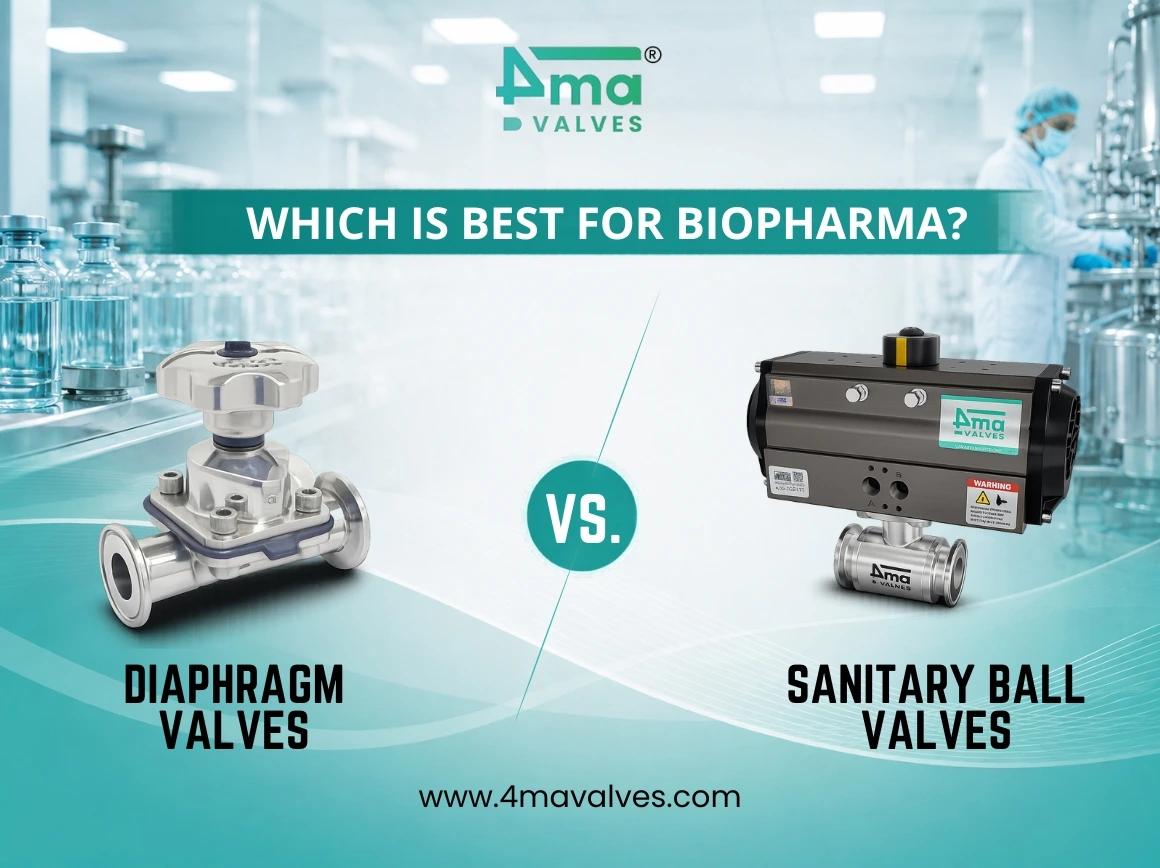
Valve selection in biopharma manufacturing is not a straightforward procurement decision. The valves used in cell culture media preparation, buffer handling, sterile filtration, and final fill-finish operations must satisfy a demanding combination of requirements: hygienic design, cleanability, sterility assurance, regulatory compliance, and long-term process reliability.
Two valve types come up most often in biopharma engineering discussions: the diaphragm valve and the sanitary ball valve. Both are widely used. Both have genuine strengths. But they are not interchangeable, and specifying the wrong type for a critical process step can create maintenance headaches, validation challenges, and contamination risks that take significant time and resources to resolve.
This article sets out a practical, side-by-side comparison to help process engineers make an informed choice for their specific biopharma applications.
Understanding the Basics
What Is a Diaphragm Valve?
A diaphragm valve controls flow using a flexible membrane, typically EPDM, PTFE-lined EPDM, or pure PTFE that is pressed against a weir or saddle in the valve body to achieve closure. The diaphragm acts as both the flow control element and the seal, physically separating the process fluid from the actuator and valve bonnet.
Because there are no internal crevices, no stem packing, and no moving metal parts in contact with the process fluid, diaphragm valves are considered the gold standard for sterile and aseptic biopharma applications.
What Is a Sanitary Ball Valve?
A sanitary ball valve uses a drilled spherical plug in the ball to control flow. When the ball is rotated 90 degrees, the bore aligns with the pipeline, and flow passes through. When closed, the solid surface of the ball blocks flow against the seat rings.
Sanitary ball valves are constructed to hygienic standards, full-bore design, polished internal surfaces, and hygienic valve-compliant materials, making them suitable for a wide range of food, beverage, and pharmaceutical applications.
Diaphragm Valves: Strengths and Limitations
Key Strengths
- Zero dead legs, the diaphragm design eliminates internal crevices where process fluid can stagnate.
- Full separation of process fluid from the actuator is critical for sterility assurance in aseptic manufacturing.
- Excellent CIP and SIP compatibility, the smooth internal weir profile allows unrestricted cleaning flow.
- Well-established in regulatory frameworks, diaphragm valves are referenced in ISPE Baseline Guides and are routinely used in FDA-inspected facilities.
- Available in single-use configurations, important for multi-product facilities where cross-contamination risk must be eliminated.
Limitations
- Higher flow resistance compared to full-bore ball valves — the weir geometry creates a pressure drop that must be accounted for in hydraulic design.
- The flexible membrane of the diaphragm has a finite service life and must be replaced at defined intervals.
- Not suitable for slurries or highly viscous media that could damage the diaphragm under actuation force.
- Higher cost per unit compared to equivalent sanitary ball valves.
Sanitary Ball Valves: Strengths and Limitations
Key Strengths
- Full-bore design provides minimal flow restriction, important in high-flow transfer lines and CIP return circuits.
- Excellent shut-off performance, tight bubble-tight closure suitable for isolation duties.
- Robust construction handles a wide range of pressures, temperatures, and media types.
- Cost-effective for general-purpose isolation duties, a well-specified pharma ball valve offers strong performance at a competitive price point.
- Lower maintenance frequency compared to diaphragm valves when used in appropriate applications.
Limitations
- Ball valve designs with cavity pockets between the ball and body can create dead zones that are difficult to clean critical to specify cavity-filled or drainable designs for hygienic applications.
- Stem packing presents a potential ingress point for contamination that must be managed through correct seal specification.
- Not recommended as the primary valve type in sterile or aseptic process areas where diaphragm valves are the regulatory expectation.
- Modulating control performance is limited compared to purpose-designed control valves.
Head-to-Head Comparison
| Criteria | Diaphragm Valve | Sanitary Ball Valve |
|---|---|---|
| Dead leg risk | None | Low-moderate (design dependent) |
| Sterility assurance | Excellent | Good |
| CIP/SIP suitability | Excellent | Good |
| Flow resistance | Moderate | Low (full bore) |
| Maintenance frequency | Higher (diaphragm wear) | Lower |
| Regulatory acceptance | Gold standard for sterile | Accepted for general pharma |
| Cost | Higher | Lower |
| Single-use option | Yes | Limited |
Which Should You Choose for Biopharma?
For sterile manufacturing areas, upstream bioprocessing, sterile filtration, and aseptic filling, the diaphragm valve is the correct choice in almost every case. Its separation of process fluid from the actuator, its dead-leg-free design, and its well-established regulatory track record make it the standard for a reason.
For utility services, buffer preparation areas, and general-purpose isolation duties where sterility assurance requirements are less stringent, a correctly specified sanitary ball valve is entirely appropriate and offers a more economical solution with lower flow resistance.
The key is not to apply one valve type universally across the facility. Work with an experienced pharma valve manufacturer who can review your P&IDs, process risk assessments, and regulatory requirements, and recommend the right valve type for each service.
Applications in Biopharma Manufacturing
Diaphragm Valves Are Typically Used In:
- Cell culture media and buffer preparation vessels
- Sterile filtration skids and bioreactor inlet/outlet lines
- Aseptic filling and dispensing systems
- Single-use bioprocessing assemblies
- WFI (water for injection) distribution systems
Sanitary Ball Valves Are Typically Used In:
- Purified water and process water distribution
- CIP supply and return circuits
- Utility isolation steam, compressed air, nitrogen
- General-purpose isolation on non-sterile process lines
- Tank venting and drain valves in buffer preparation
Get Expert Valve Guidance from 4ma Valves Automation
4ma Valves Automation supplies a comprehensive range of biopharma-grade diaphragm valves, sanitary ball valves, and automated valve solutions validated for sterile and aseptic manufacturing environments. Our team can support you through valve selection, documentation, and validation.
Contact us today: www.4mavalves.com/contact
Conclusion
Diaphragm valves and sanitary ball valves both have a legitimate place in biopharma manufacturing, but they serve different purposes. Diaphragm valves deliver the sterility assurance and hygienic design required for critical sterile process areas. Sanitary ball valves offer robust, cost-effective performance for general-purpose duties and utility services.
The most effective biopharma facilities use both, selecting each type based on process risk, regulatory expectation, and engineering requirements. A knowledgeable pharma valve manufacturer will help you get that specification right from the outset.
Frequently Asked Questions
Are diaphragm valves better than ball valves for sterile pharmaceutical manufacturing?
For sterile and aseptic pharmaceutical manufacturing, diaphragm valves are generally preferred. Their design eliminates dead legs, separates process fluid from the actuator, and provides the cleanability required for sterility assurance. Sanitary ball valves are appropriate for non-sterile duties and utility services but are not typically specified as the primary valve type in sterile process areas.
What is a sanitary ball valve and how does it differ from a standard ball valve?
A sanitary ball valve is designed and manufactured to hygienic standards — full-bore internal geometry, polished product-contact surfaces, and materials that comply with FDA and other food and pharmaceutical regulations. Standard industrial ball valves are not manufactured to these standards and are not suitable for use in food or pharmaceutical process lines.
Can diaphragm valves handle high-pressure applications in biopharma?
Diaphragm valves have pressure limitations that are lower than those of metal-seated ball valves. Most pharma-grade diaphragm valves are rated for pressures up to approximately 10 bar, depending on size and diaphragm material. For higher-pressure applications, alternative valve types should be evaluated with your pharma valve manufacturer.
How often do diaphragm valve membranes need to be replaced?
Replacement intervals depend on the diaphragm material, process media, CIP/SIP cycle frequency, and operating conditions. As a general guide, diaphragm membranes in active pharmaceutical manufacturing should be inspected every three to six months and replaced at defined cycle count intervals as specified by the valve manufacturer. Actual intervals should be established through your validation and maintenance programme.
What certifications should biopharma valves carry?
Biopharma valves should carry 3-A Sanitary Standards certification and/or EHEDG certification, and all wetted materials should comply with FDA 21 CFR regulations. For facilities subject to GMP oversight, full material traceability documentation, including material test reports and surface finish certificates, is typically required.
 Group of Company


