Quick answer: A sanitary valve's real service life is determined as much by spare parts availability and after-sales support as by its original build quality. Seats, seals, diaphragms, and actuator components wear out through normal CIP/SIP cycling and actuation — what determines whether that's a routine maintenance task or an unplanned production stoppage is whether replacement parts are stocked, documented, and quickly accessible, with engineering support available when something doesn't perform as expected.
A valve doesn't fail all at once. Long before a ball valve seizes or a diaphragm ruptures, there are warning signs — slightly increased actuation time, minor seepage, a seal that's lost its elasticity. Plants that catch these early and have ready access to the right spare part keep running. Plants that don't — often because the original supplier is slow to respond, doesn't stock parts locally, or can't confirm which part matches which valve — end up with unplanned downtime that costs far more than the part itself. This article covers what proper spare parts and after-sales support should actually look like, and why it matters as much as the valve's original specification.
Why Spare Parts Support Is Part of Valve Performance, Not an Afterthought
It's tempting to treat spare parts and after-sales service as a secondary consideration behind the initial valve purchase decision. In practice, they're part of the same decision:
Wear parts wear out by design, not by failure. Seats, seals, gaskets, and diaphragms are consumable components in any hygienic valve. Regular CIP/SIP cycling, chemical exposure, and actuation cycles mean these parts have a finite service life even on a correctly specified, well-built valve. Planning for replacement isn't a sign something went wrong — it's normal maintenance.
Availability determines downtime, not the failure itself. A worn seal is a five-minute fix if the right part is on hand and the replacement procedure is documented. The same worn seal becomes a multi-day or multi-week production stoppage if the part has to be sourced, imported, or custom-made.
Documentation determines speed. Maintenance teams need to know exactly which seal compound, which seat material, and which dimensional spec matches their specific valve — without guesswork or a lengthy back-and-forth with the supplier.
What Full Spare Parts Coverage Looks Like
For the valve types we manufacture — sanitary ball valves, sanitary butterfly valves, pharma diaphragm valves, sanitary control valves, and sampling valves — the components that typically need replacement over a valve's service life include:
- Seats and seals — the components most exposed to repeated CIP/SIP cycling and chemical attack
- Diaphragms — in diaphragm valves, the component most directly subject to flex-fatigue over repeated actuation
- O-rings and gaskets — smaller components that are easy to overlook but critical for sealing integrity
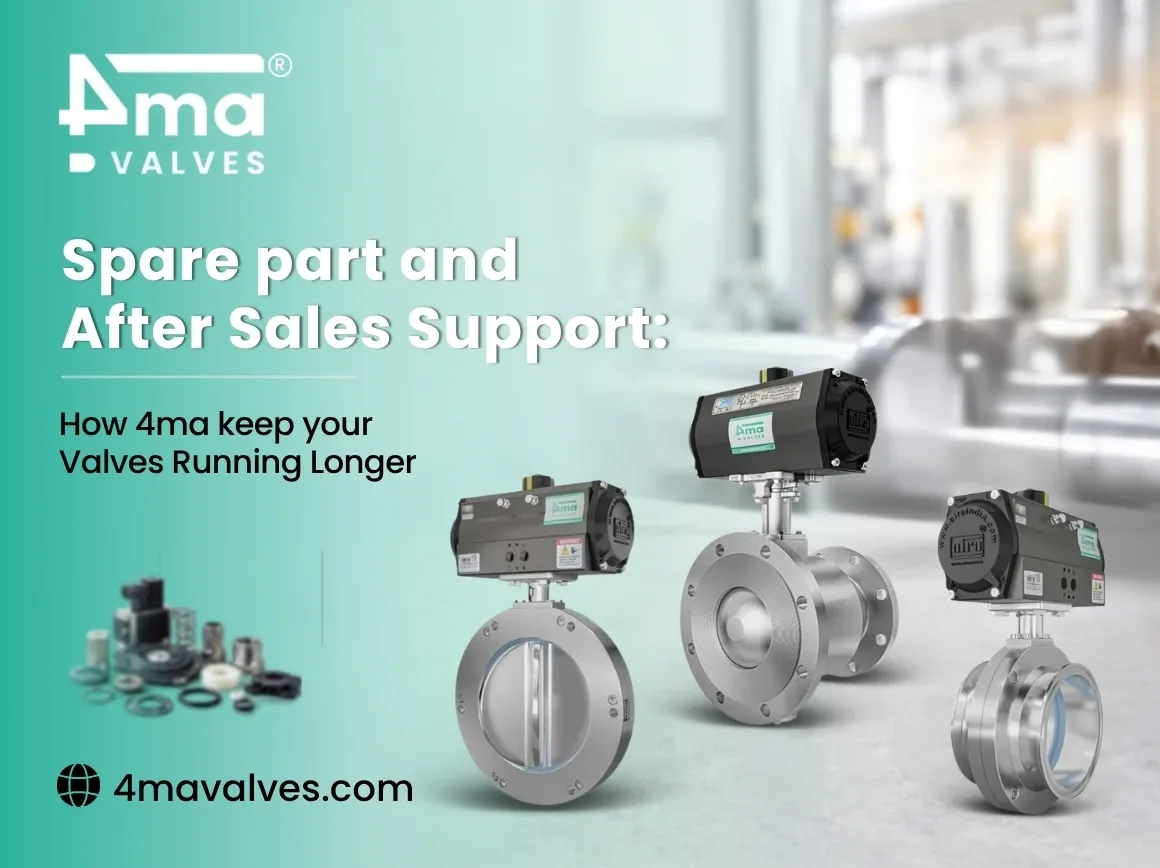
- Actuator components — for valves fitted with pneumatic actuators, components like solenoid valves, positioners, and limit switches that wear or drift out of calibration over time
Stocking these parts domestically, with clear documentation tying each part to the exact valve model and configuration it fits, is what turns routine maintenance into a same-week fix rather than a weeks-long wait.
How After-Sales Support Should Actually Work
Spare parts alone aren't enough without the support to use them correctly. Effective after-sales support typically includes:
Direct access to engineering, not just a sales line
When a valve isn't performing as expected — slower actuation, inconsistent sealing, unusual wear — getting a straight answer from someone who understands the valve's design, not just its order history, is what actually resolves the issue quickly.
Maintenance guidance matched to your specific valve and application
Generic maintenance schedules are a starting point, but real guidance accounts for your specific CIP/SIP frequency, product chemistry, and actuation cycle count — all of which affect how often parts actually need replacement in your particular application.
Clear part identification
Every spare part request should be resolvable from the original valve documentation — model, configuration, and seal/seat material — without extended back-and-forth to identify what's needed.
Support for valve audits and preventive maintenance planning
For plants operating under GMP or similar regulatory frameworks, after-sales support should extend to helping maintenance teams plan preventive replacement schedules that satisfy both operational reliability and audit documentation requirements.
Why This Matters More for Domestically Manufactured Valves
This is one of the clearest, most practical advantages of sourcing valves from a manufacturer with local production and stock, rather than a purely imported alternative. We've written in more detail about how this plays into total lifetime cost in why cheap imported valves cost more long-term — spare parts availability is consistently one of the largest hidden cost factors buyers underestimate at the point of purchase.
Because we manufacture in Ahmedabad and maintain stock of common wear parts for our own valve range, maintenance teams working with us typically see dramatically faster turnaround on replacement parts than they would sourcing from an overseas supplier or distributor layer.
Extending Valve Life: What Maintenance Teams Can Do Proactively
Beyond having parts available when needed, a few practices extend valve service life and reduce unplanned replacement frequency:
- Track actuation cycle counts where possible, particularly on high-cycle automated valves, to anticipate wear parts replacement before failure
- Inspect seats and seals during scheduled CIP downtime, rather than waiting for a visible leak or failure
- Confirm CIP/SIP chemical compatibility periodically, especially if cleaning chemistry or concentration has changed since the valve was originally specified
- Keep a small on-site stock of the most common wear parts — seats, seals, and gaskets — for the valves most critical to production continuity
- Maintain documentation linking each valve to its exact spare parts specification, so replacement doesn't depend on institutional memory
What Comes With Every 4MA Valves Order
Every valve we supply is backed by documented spare parts specifications and direct access to our engineering team for maintenance and troubleshooting support — continuing the same relationship that starts during the ordering and installation process.
Final Thoughts
A valve's long-term reliability depends on more than its original build quality — it depends on whether worn parts can be identified and replaced quickly, and whether engineering support is available when something doesn't perform as expected. Spare parts availability and after-sales support aren't an add-on to a good valve purchase decision; they're part of it.
If you need spare parts for an existing valve or want to talk through a maintenance plan for your line, get in touch with our team or explore our full product range to see what we support.