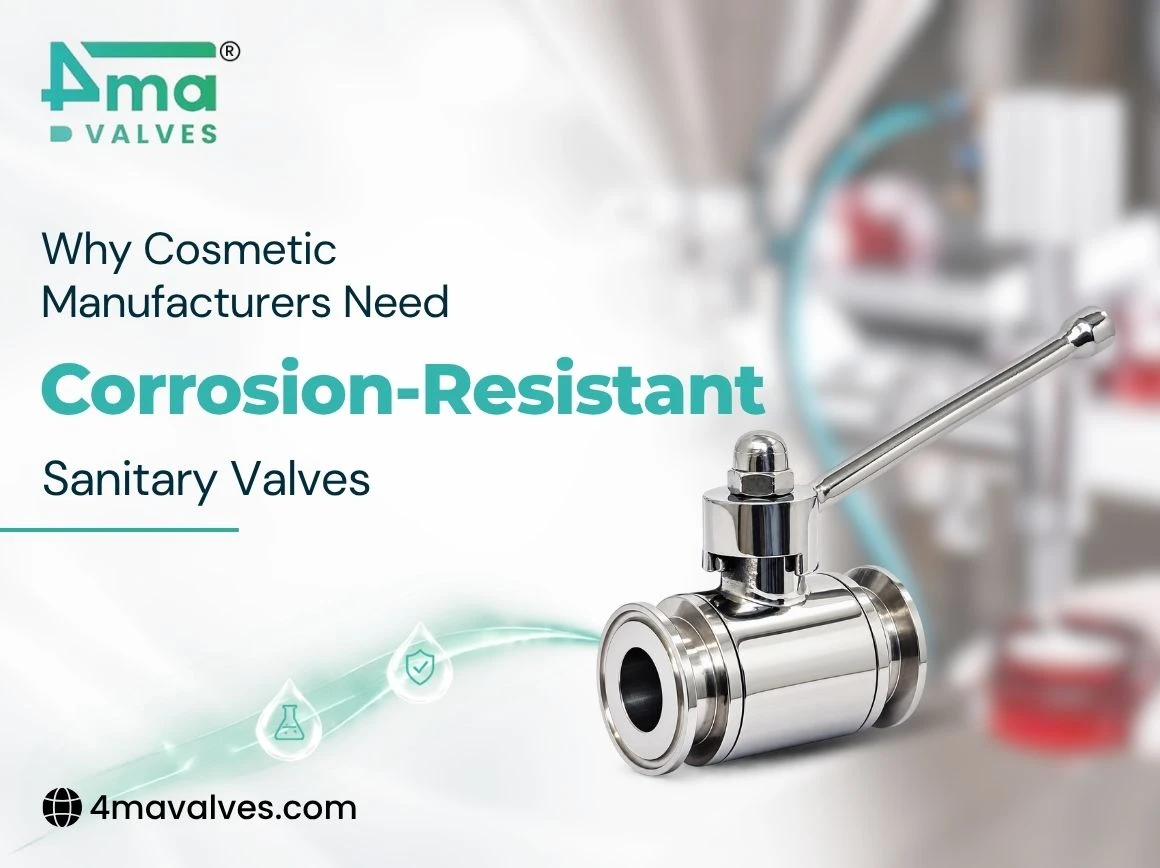
Quick answer: Cosmetic formulations routinely contain surfactants, acids, preservatives, essential oils, and salts that attack ordinary metals over time. Corrosion-resistant sanitary valves — typically built in 316L stainless steel with crevice-free, CIP/SIP-compatible designs — stop pitting and rust particles from contaminating batches, keep seals from degrading prematurely, and protect the hygiene compliance that regulators and brand-safety audits demand. For manufacturers running formulation, mixing, and filling lines, the valve is not a minor fitting — it is one of the few components that touches every batch, every day.
If you manufacture creams, lotions, gels, shampoos, or serums, you already know that a "small" valve failure rarely stays small. A pitted valve seat can shed micro-particles of metal into a batch. A degraded gasket can trap bacteria in a crevice that no CIP cycle reaches. A stuck diaphragm can hold up an entire filling line for a shift. This article breaks down why corrosion resistance is non-negotiable in cosmetic manufacturing, what actually causes valve corrosion on formulation lines, and how to choose valves that hold up under real production conditions.
Why Corrosion Is a Bigger Risk in Cosmetics Than People Expect
Cosmetic formulations are chemically more hostile to metal than most people assume. A single production line might process, in the same week:
- Surfactant-heavy cleansers with high chloride content
- Acidic actives — glycolic acid, salicylic acid, vitamin C derivatives
- Alkaline emulsions used to stabilize creams and lotions
- Preservative systems containing chlorides, phenoxyethanol, or organic acids
- Essential oils and fragrance compounds that are mildly corrosive over prolonged contact
- Frequent CIP/SIP cycles using caustic and acid washes, often multiple times a day
Chlorides are the biggest culprit. They attack the passive oxide layer that protects stainless steel, leading to pitting corrosion — small, localized pits that are easy to miss on a visual inspection but that steadily undermine the integrity of a valve body, seat, or diaphragm. Once pitting starts, it accelerates: pits trap residue, residue traps moisture and chlorides, and the cycle repeats until the valve either leaks or contaminates the product stream.
This is why generic industrial valves, even "stainless" ones made from lower grades like 304, often underperform in cosmetic plants. The difference between 304 and 316L stainless steel comes down to molybdenum content — 316L includes 2–3% molybdenum, which significantly improves resistance to chloride-induced pitting and crevice corrosion. For a plant running acidic actives and chloride-heavy surfactants daily, that difference determines whether a valve lasts five years or fails in eighteen months.
What Happens When Valves Aren't Corrosion-Resistant
The consequences of using the wrong-grade valve rarely show up on day one. They show up gradually, and usually in ways that are expensive to trace back to the root cause:
1. Metal particulate contamination. Pitted or corroded internal surfaces can release microscopic metal fragments into the product. In cosmetics, this isn't just a quality issue — it's a consumer-safety issue that can trigger batch recalls.
2. Compromised hygienic design. Corrosion creates micro-crevices that standard clean-in-place (CIP) cycles cannot fully reach. Bacteria and biofilm can establish themselves in these pits, defeating the purpose of a hygienic valve design in the first place.
3. Seal and gasket degradation. Valve seats corroded by acidic or chloride-rich media stop sealing properly, leading to internal leakage, cross-contamination between product runs, and inconsistent batch quality.
4. Increased downtime and replacement cost. Replacing a valve mid-production run costs far more than the part itself — it means stopped lines, wasted batch material, and CIP re-validation.
5. Regulatory and audit exposure. Cosmetic GMP audits (and increasingly, retailer/brand safety audits) scrutinize product-contact materials closely. A corroded valve is a documented finding, not just an engineering inconvenience.
What Makes a Sanitary Valve Genuinely Corrosion-Resistant
Not every valve labeled "stainless steel" or "sanitary" is built to the same standard. When evaluating valves for a cosmetic formulation or filling line, four things matter most:
1. Material grade
316L stainless steel is the practical minimum for cosmetic product-contact surfaces. It resists pitting from chlorides and organic acids far better than 304, and the low-carbon ("L") designation reduces the risk of carbide precipitation during welding, which is where a lot of hidden corrosion starts in cheaper valve builds.
2. Surface finish
A mirror or electropolished internal finish (commonly Ra ≤ 0.8 µm) matters as much as the base material. Rougher surfaces give corrosive media and residue more places to cling to, accelerating pitting and making CIP cycles less effective.
3. Crevice-free, hygienic geometry
Dead legs, threaded connections, and gasket designs with hidden gaps are where corrosion — and contamination — start. Diaphragm valves and properly designed ball or butterfly valves with continuous, crevice-minimized flow paths hold up far better under repeated CIP/SIP cycling.
4. CIP/SIP compatibility
A valve that can't handle the actual caustic and acid concentrations used in your CIP program will corrode regardless of base material. Confirming CIP/SIP compatibility with the valve manufacturer — not just assuming it — is a step worth taking before specification, not after installation.
Valve Types Commonly Used in Cosmetic Manufacturing
Different points on a formulation and filling line call for different valve types:
- Diaphragm valves — well suited to sterile or near-sterile transfer points, sampling lines, and applications where zero dead-leg design is critical
- Ball valves — used widely for general product transfer and batching, where 316L construction and hygienic seat design prevent product hold-up
- Sampling valves — allow QC to draw batch samples without opening the line to contamination risk
- Tank bottom and flush bottom valves — critical at mixing vessel outlets, where residue buildup and corrosion risk are highest due to constant product contact
If you're specifying valves for a new or upgraded line, it's worth reviewing our full range of hygienic valves and automation accessories to match valve type to the specific duty point on your line, rather than defaulting to one valve style across the whole system.
How This Plays Out on a Real Formulation Line
Consider a typical cream or lotion line: raw materials are received and staged, ingredients are dosed into a mixing vessel, the batch is emulsified, and the finished product is transferred to filling. At nearly every one of those steps — dosing, mixing vessel outlet, transfer piping, filling manifold — a valve is in direct, repeated contact with product and cleaning chemicals.
Corrosion resistance isn't a single decision made once — it's a specification standard that has to be applied consistently across every valve on the line. A single non-compliant valve, even in a "low-risk" spot like a rinse-water line, can become the entry point for contamination or the source of an unexplained recurring CIP failure.
Where Cosmetic Manufacturing Overlaps With Pharma-Grade Standards
Many cosmetic manufacturers — particularly those producing actives-based skincare, nutricosmetics, or products sold in regulated markets — are increasingly expected to meet hygiene standards closer to pharmaceutical GMP than traditional cosmetic manufacturing. This is one reason we support cosmetic producers with the same valve technology used across our pharmaceutical industry and food industry product lines — the underlying hygienic design and corrosion-resistance requirements are closely related, even when the regulatory frameworks differ.
You can see how this applies specifically to cosmetic and personal care manufacturing on our cosmetic industry solutions page,where we outline how we support raw material reception, dosing, mixing, and filling line equipment for cosmetic producers.
Practical Checklist Before You Specify Valves for a Cosmetic Line
- Confirm 316L (or higher) stainless steel for all product-contact surfaces
- Verify internal surface finish specification (Ra value) with your supplier
- Choose valve geometry with minimal dead legs and crevice-free seating
- Confirm CIP/SIP chemical compatibility against your actual cleaning program, not generic assumptions
- Request material traceability and certification documentation for audit readiness
- Match valve type (diaphragm, ball, sampling, tank bottom) to the specific duty point on the line
For a broader, step-by-step version of this process, our sanitary valve buying checklist covers the same questions in more depth, applicable across food, dairy, and cosmetic processing.
Final Thoughts
Corrosion resistance in sanitary valves isn't a premium feature for cosmetic manufacturers — it's baseline protection for product quality, batch consistency, and regulatory standing. The cost difference between a properly specified 316L valve and a generic alternative is small compared to the cost of a contaminated batch, an unplanned line stoppage, or a failed audit finding.
If you're specifying or upgrading valves for a cosmetic formulation, mixing, or filling line, our team can help you match valve type, material grade, and CIP compatibility to your exact process conditions. Get in touch with our engineering team or explore our complete product range to start the conversation. You can also read more about our company and manufacturing standards here.
Frequently Asked Questions
Why can't cosmetic manufacturers just use standard 304 stainless steel valves?
304 stainless steel lacks the molybdenum content that gives 316L its resistance to chloride-induced pitting. In cosmetic formulations containing surfactants, preservatives, and acidic actives, 304 valves typically show pitting and corrosion far sooner than 316L, shortening service life and increasing contamination risk.
How often should corrosion-resistant valves be inspected in a cosmetic plant?
Most manufacturers build valve inspection into routine preventive maintenance schedules, checking seals, seats, and visible surfaces for early pitting at intervals aligned with CIP cycle frequency and batch volume — often quarterly for high-throughput lines.
Do all cosmetic products require the same level of valve corrosion resistance?
No. Products with higher chloride, acid, or salt content — cleansers, exfoliants, acid-based actives — place more stress on valves than low-reactivity formulations like anhydrous balms or oils. Line-wide 316L specification is still the safest baseline, since production is rarely limited to a single formulation type.