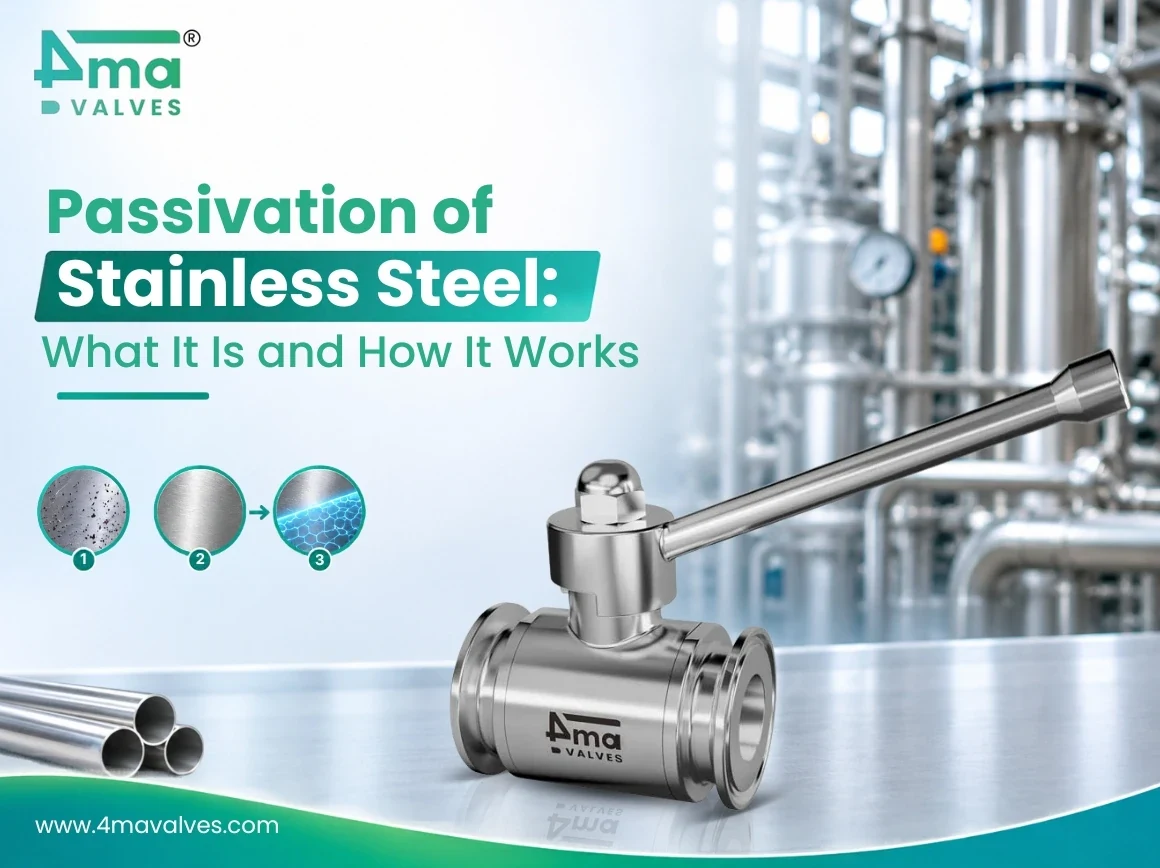
Stainless steel is not “stainless” because it is immune to rust. It resists rust because of an invisible, self-healing skin, only a few nanometres thick, that forms on its surface. Passivation is the process that cleans that skin and helps it form properly.
If you buy, weld, machine or maintain stainless steel equipment, especially in pharma, food, dairy or beverage plants, understanding passivation will save you from rust spots, failed audits and expensive rework.
Quick answer: Passivation of stainless steel is a chemical treatment, usually with citric or nitric acid, that removes free iron and other surface contamination from the metal and promotes the formation of a uniform chromium-oxide passive layer. This layer protects the steel from corrosion. It is typically done after fabrication, machining or welding, and is governed by standards such as ASTM A967 and ASTM A380.
Why Stainless Steel Resists Corrosion in the First Place
Stainless steel contains a minimum of about 10.5% chromium. When chromium meets oxygen, either from air or water, it forms an extremely thin chromium-oxide film on the surface. This film is:
- Very thin, typically only a few nanometres, invisible to the eye
- Tightly bonded to the metal underneath
- Self-repairing, because a scratch re-forms the film in the presence of oxygen
That film is the “passive layer”, and the state of being protected by it is called being “passive”. The name passivation simply comes from that.
What Is Passivation?
Passivation is a post-fabrication treatment that does two jobs:
- Removes free iron and contaminants from the surface, such as embedded steel particles from tools, machining residues, oils and scale-forming deposits
- Encourages a clean, uniform passive layer by exposing the chromium-rich surface to an oxidising environment
It is important to understand what passivation does not do. It does not add a coating, it does not change the dimensions of the part in any meaningful way, and it does not make poor-quality or badly welded steel corrosion-proof. It restores the steel’s natural corrosion resistance by removing what interferes with it.
Why Passivation Is Needed: What Goes Wrong Without It
Even high-grade 316L can lose corrosion resistance during manufacturing. Common culprits:
- Free iron contamination. Cutting tools, grinding wheels, wire brushes and fixtures made of carbon steel leave tiny iron particles embedded in the surface. These rust, and the rust stains the surrounding stainless steel.
- Machining and forming. Cutting heat and mechanical stress disturb the surface chemistry.
- Welding. The heat of welding creates a discoloured heat-tint oxide layer and depletes chromium near the weld, weakening local corrosion resistance.
- Handling and storage. Contact with carbon steel racks, chains or dust leaves iron behind.
Left alone, these contaminants become starting points for rust spots, pitting and, in sterile plants, a source of the reddish deposits known as rouge.
The Stainless Steel Passivation Process: Step by Step
A typical passivation workflow looks like this:
Step 1: Degrease and clean. Oils, grease, coolant and fingerprints are removed with an alkaline cleaner or solvent. This step is critical: acid cannot work properly through an oil film, and skipping it is the number one cause of failed passivation.
Step 2: Remove heat tint and scale, if present. Weld discoloration and scale are removed by pickling or mechanical/chemical methods. Light passivation alone does not remove heavy heat tint.
Step 3: Rinse. Clean water rinse to remove cleaning residues.
Step 4: Acid treatment. The part is immersed in, or circulated with, a passivating acid solution. The two main options are nitric acid and citric acid, each with a set of solution strengths, temperatures and times defined in the governing standard.
Step 5: Final rinse. Thorough rinsing with clean, preferably deionised or purified water. Any acid left behind can cause new problems.
Step 6: Dry. Parts are dried cleanly, especially important in hygienic applications.
Step 7: Test and document. The surface is verified, and the results recorded in a certificate.
The exact concentrations, temperatures and immersion times are set by the chosen method in the standard and the grade of stainless steel. These should always be followed as written rather than approximated.
Citric Acid vs Nitric Acid Passivation
| Factor | Nitric acid | Citric acid |
| Effectiveness | Long established, very effective | Equally effective on most grades when properly applied |
| Safety | Strong oxidiser, hazardous fumes, stricter handling | Much safer, milder handling |
| Environment | Hazardous waste, stricter disposal | Biodegradable, easier disposal |
| Free-machining grades | Can attack some grades with added sulfur | Generally gentler |
| Industry trend | Traditional | Increasingly preferred, especially in pharma and food |
Both are recognised in ASTM A967. Many hygienic-industry users now prefer citric acid because it is safer for workers and the environment while delivering comparable results on the austenitic grades used for sanitary equipment such as 304 and 316L.
Key Standards for Passivation
- ASTM A967: Standard specification for chemical passivation treatments for stainless steel parts. It lists the nitric and citric acid methods and the acceptable ways to test the result.
- ASTM A380: Standard practice for cleaning, descaling and passivating stainless steel parts, equipment and systems.
- ASME BPE: The bioprocessing equipment standard, widely followed in pharma and biotech, which addresses surface finish, passivation and documentation for hygienic systems.
If you are specifying equipment, naming the standard and method in your purchase order removes ambiguity about what “passivated” means.
How Passivation Is Tested
Passivation is only useful if it can be shown to have worked. Common verification approaches include:
- Water immersion and high-humidity tests, which look for rust staining after exposure to moisture
- Copper sulfate test, where free iron causes copper to plate out on the surface (suitable for certain grades only)
- Ferroxyl or potassium ferricyanide tests, which turn blue where free iron is present
- Visual inspection for stains, discolouration and uniform appearance
The right test depends on the grade of steel and the standard being followed. For regulated industries, results are recorded and certified.
Passivation vs Pickling vs Electropolishing
These three terms are often confused:
- Passivation removes free iron and promotes the passive layer. It is gentle and removes almost no base metal.
- Pickling uses stronger acid mixtures to remove weld scale and heavy heat tint, and it removes a thin layer of metal. It is usually followed by passivation.
- Electropolishing uses electric current in an acid bath to remove a micro-thin surface layer, smoothing peaks and producing a bright, very clean, chromium-enriched surface. It is often used in pharma, and parts are typically passivated afterwards.
They are complementary, not competing. A sensible hygienic finish often combines a smooth surface finish, controlled welding and passivation.
When Should You Passivate Stainless Steel?
You should consider passivation when:
- Parts have been machined, ground, bent, welded or polished
- New piping, tanks or valves are being installed or commissioned
- Equipment shows rust spotting or tea-coloured staining
- A system has been modified, repaired or exposed to carbon steel contamination
- Your quality system or customer specification requires a certified passive surface, which is the norm in pharma, biotech, food and dairy
Common Passivation Mistakes
Skipping the degreasing step. Acid cannot passivate through oil.
- Using the wrong method for the grade. Free-machining or certain martensitic grades need different treatment.
- Poor rinsing. Acid or chloride residues cause later pitting.
- Using contaminated tools or baths. A dirty bath redeposits iron.
- Expecting passivation to fix bad welds or rough surfaces. It cannot.
- No test or record. Without verification, you cannot prove it worked.
What Passivation Means When You Buy Sanitary Valves
Valves used in pharma, dairy, food and beverage lines are made from 316L or similar stainless steel precisely because the passive layer must stay intact through repeated cleaning-in-place and steam-in-place cycles. When you evaluate a supplier:
- Ask whether passivation is performed and which standard it follows
- Ask for material certificates and traceability for wetted parts
- Check that the supplier controls machining, finishing and testing in one place so that contamination does not creep in between steps
4MA Valves builds hygienic valves in 316L stainless steel with CIP/SIP-compatible geometries, material traceability and in-house pressure and leak testing. Explore the range of sanitary ball valves, sanitary butterfly valves, pharma diaphragm valves and sanitary non return valves.
Looking for Hygienic Stainless Steel Valves for Your Plant?
Our team can help you specify the right 316L valves for your pharma, food, dairy, beverage or cosmetic process. See the industries we serve, request documents from our downloads page, or contact us or call +91 8733005449.