In the historical landscape of fluid handling, “hygienic design” and “high-tech automation” were often at odds. To maintain the strict standards required by the FDA and EHEDG, valves needed to be simple, smooth, and devoid of any complex external attachments that could harbor bacteria or fail during high-pressure steam sterilization. However, as we move further into the decade, the rise of Industry 4.0 has changed the rules.
At 4MA Valves Automation, we have recognized that the modern processing plant can no longer survive on cleanliness alone; it requires intelligence. As a leading hygienic valve manufacturer in India, we are helping our clients bridge this gap. The solution lies in integrating advanced Smart Pneumatic Linear Valve Positioners into traditional hygienic frameworks, creating a system that is as data-rich as it is sterile.
The Evolution of the “Connected” Sanitary Plant
Industry 4.0 is often discussed in terms of robotics and big data, but in a liquid processing facility, it starts at the valve. For years, the valve was a “black box”—you knew if it was open or closed, but you didn’t know how it was performing.
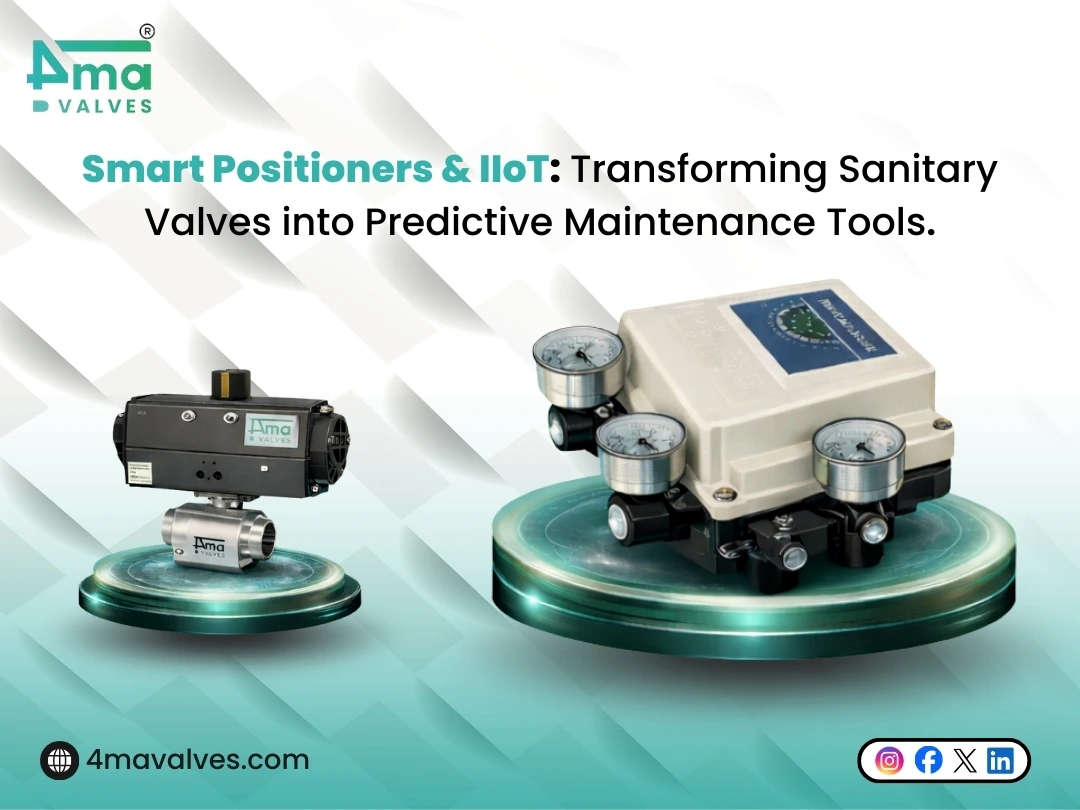
By upgrading to smart automation, you are effectively giving your piping system a central nervous system. This evolution is the natural next step from our previous discussion on Smart Positioners and Predictive Maintenance, where we explored how IIoT data prevents unplanned downtime. In this broader context, Industry 4.0 is about more than just maintenance; it is about total process optimization.
Why Hygienic Design is the Foundation
You cannot have a smart plant if your hardware fails the basic requirements of food and pharma safety. This is why 4MA Valves approaches automation differently than a standard industrial supplier. When we design a sanitary diaphragm valve, we ensure that every square millimeter of the flow path is polished to a mirror finish.
The challenge of Industry 4.0 is mounting electronics—like a Smart Pneumatic Linear Valve Positioner—onto these valves without creating “dead spaces” where contaminants can grow. Our engineering team in India has perfected this balance. By using compact, stainless-steel housings for our automation accessories, we ensure that the valve remains easy to clean while the sensors inside capture every micro-movement of the valve stem.
The Role of the Smart Positioner in Digital Transformation
A smart positioner is the primary translator between the physical world of fluid flow and the digital world of the control room. In an Industry 4.0 setup, sanitary control valves equipped with these positioners provide three distinct advantages:
- Interoperability: The valve can “talk” to other machines. For example, if a downstream pump slows down, the smart positioner can adjust the valve seat position instantly to prevent a pressure surge.
- Decentralized Decision Making: Our smart positioners can be programmed to handle specific logic locally. If the air supply drops below a certain PSI, the valve can autonomously move to a “fail-safe” position without waiting for a command from the main PLC.
- Real-Time Transparency: Gone are the days of manual logging. Every movement is time-stamped and sent to the cloud, providing an immutable record for quality assurance teams.
Integrating the Solenoid Valve into the Smart Loop
While the positioner handles the complex modulation, the solenoid valve remains the unsung hero of safety and speed. In an Industry 4.0 environment, the solenoid acts as the digital switch. By integrating high-performance solenoids into the valve manifold, we allow for lightning-fast emergency shutdowns and precise “pulsing” during CIP (Clean-in-Place) cycles.
As an experienced hygienic valve manufacturer in India, 4MA Valves understands that these components must work in perfect harmony. A smart positioner provides the “eyes,” but the solenoid provides the “reflexes.” When these two work together, your process becomes significantly more resilient to human error and utility fluctuations.
The Indian Perspective: Leading the Global Shift
By manufacturing these high-tech components locally, we provide Indian processors with world-class technology without the long lead times or high costs associated with European imports. Our sanitary diaphragm valves and automation tools are built to withstand the rigors of the Indian climate while meeting the stringent global standards required for export.
Beyond ROI: The Environmental Impact
Industry 4.0 isn’t just about profit; it’s about sustainability. A “smart” valve is a more efficient valve. By using a Smart Pneumatic Linear Valve Positioner, you can reduce the amount of compressed air wasted during operation. Furthermore, by optimizing your CIP cycles through precise valve control, you can reduce water and chemical consumption by up to 20%. For any modern facility, these environmental gains are just as important as the operational ones.
Conclusion: Partnering with 4MA Valves Automation
The gap between hygienic design and Industry 4.0 has been bridged. You no longer have to choose between a sterile process and a data-driven one.
At 4MA Valves Automation, we are dedicated to helping you navigate this transition. Whether you are looking to retrofit a single line with sanitary control valves or you are designing a completely new, IIoT-enabled facility from the ground up, we have the expertise and the hardware to make it a reality.
As a trusted hygienic valve manufacturer in India, we don’t just sell products; we provide the building blocks for the future of processing.

 Group of Company


