In the high-pressure world of hygienic processing, the cost of “not knowing” is higher than it has ever been. For decades, plant managers in the food, dairy, and pharmaceutical sectors have operated under a cloud of uncertainty. Will a diaphragm fail mid-batch? Is a control valve drifting out of calibration? Historically, the only way to answer these questions was to stop production, dismantle the hardware, and inspect it manually.
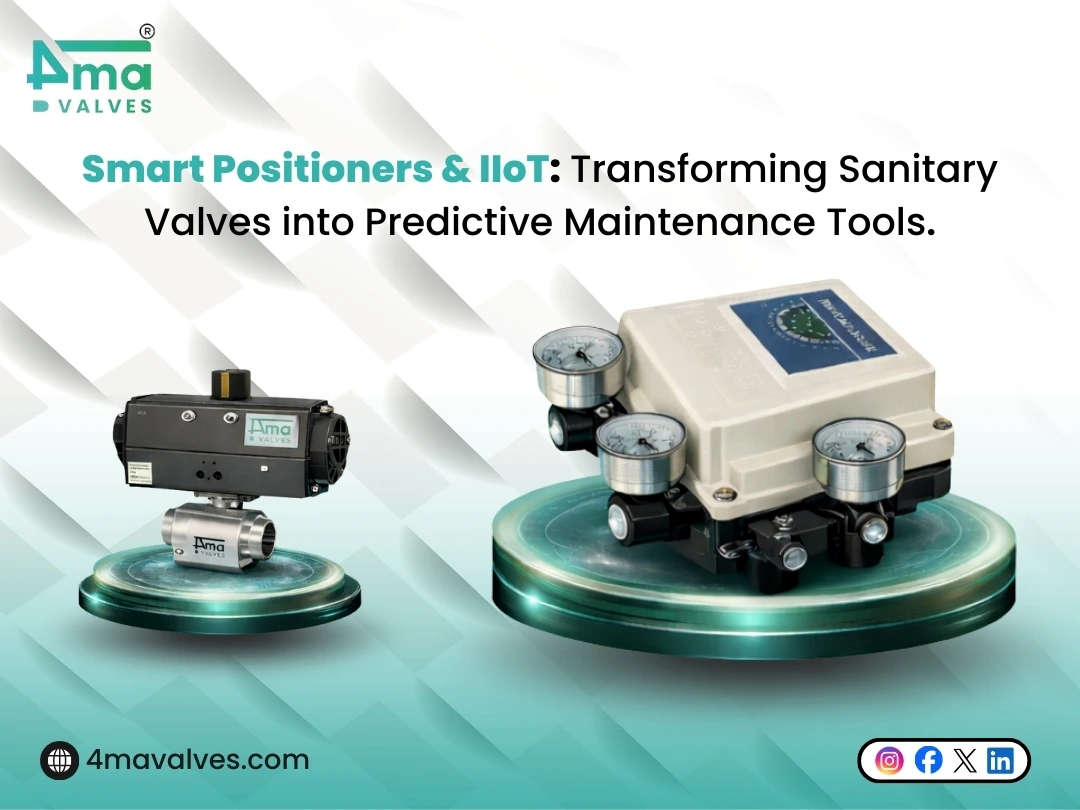
At 4MA Valves Automation, we believe that in the era of Industry 4.0, your hardware should speak for itself. As a premier hygienic valve manufacturer in India, we are seeing a fundamental shift in how facilities manage their assets. The secret lies in the integration of the Smart Pneumatic Linear Valve Positioner, advanced solenoid valves, and the Industrial Internet of Things (IIoT). Together, these technologies are transforming traditional sanitary control valves from simple mechanical components into intelligent, predictive maintenance tools.
The Problem with “Run-to-Fail” Maintenance
Most sanitary plants still rely on preventive maintenance schedules—changing seals and diaphragms every six months regardless of their actual condition. While this is safer than waiting for a catastrophic leak, it is incredibly wasteful. You are often throwing away perfectly good components and paying for labor you don’t need.
The alternative is reactive maintenance, which is even worse. In the Pharmaceutical Industry, an undetected valve failure during a sterile fill operation doesn’t just mean a broken part; it means the loss of a multi-million rupee batch and weeks of regulatory paperwork. This is where the “Smart” in smart positioners becomes your most valuable asset.
What Makes a Positioner “Smart”?
A standard positioner simply tells a valve to open or close based on a signal. A Smart Pneumatic Linear Valve Positioner, however, acts as the “brain” of the valve assembly. It uses a microprocessor to monitor its own performance and the health of the valve it is mounted on.
When you connect this “brain” to an IIoT gateway, the data is no longer trapped at the valve. It is sent to the cloud, where it can be analyzed by maintenance teams on their smartphones or tablets. However, the positioner doesn’t work alone. In many automated loops, a high-quality solenoid valve acts as the critical pilot, ensuring that the air supply is cut or redirected instantly during an emergency or a specific process step. For a hygienic valve manufacturer in India serving global markets, this level of transparency and safety integration is no longer a luxury—it is a requirement.
Key Data Points for Predictive Success:
- Valve Signature Tracking: The positioner records the exact amount of air pressure required to move the valve. If that pressure increases over time, the system knows there is friction or product buildup before it causes a jam.
- Travel Histograms: By tracking how often a valve sits at 50% vs. 90% open, engineers can predict wear patterns on the sanitary diaphragm valve seat.
- Solenoid Performance: Monitoring the response time of the solenoid valve ensures that safety interlocks are functioning within millisecond tolerances, preventing hydraulic shock or “water hammer.”
Enhancing the Life of the Sanitary Diaphragm Valve
The sanitary diaphragm valve is the workhorse of the biotech and food industries because of its “weir-style” cleanliness. However, the diaphragm is a flexible part that eventually wears out. In a traditional setup, you have no way of knowing when a diaphragm is about to rupture.
By using smart positioners, 4MA Valves provides a way to monitor the “dynamic change” in the valve’s movement. If the response time slows down by even a few milliseconds, it could indicate that the diaphragm is losing its elasticity. Catching this early means you can schedule a 15-minute replacement during a routine cleaning cycle rather than dealing with a 10-hour emergency cleanup after a rupture.
Bridging the Gap in Indian Manufacturing
As an Indian manufacturer, 4MA Valves is uniquely positioned to help local industries upgrade their infrastructure. We understand the specific challenges of the Indian market—from fluctuating utility pressures to the need for rugged, washdown-safe equipment. Our automation accessories, including our specialized solenoid valve range, are designed to be “plug-and-play.” This allows you to turn a standard manual manifold into an automated, IIoT-ready system without a total plant redesign.
The ROI of Intelligent Automation
Many facility owners ask: “Is the investment in smart technology worth it?” The answer is found in the OEE (Overall Equipment Effectiveness).
- Reduced Spare Parts Inventory: Stop buying diaphragms you don’t need yet. Buy them exactly when the data says it’s time.
- Energy Savings: A smart positioner can detect internal air leaks in the actuator. Fixing a single leak can save thousands of rupees in compressed air costs over a year.
- Audit-Ready Documentation: In the Dairy Industry, proving that a valve was fully closed during a CIP (Clean-in-Place) cycle is vital for safety. Smart positioners and solenoid logs provide this data automatically, making your next audit seamless.
Conclusion
The transition to predictive maintenance is about moving from a state of “defense” to a state of “offense.” You are no longer waiting for the plant to break; you are controlling exactly when and how maintenance happens.
At 4MA Valves Automation, our mission is to provide the hardware that makes this digital journey possible. Whether you are looking for a high-performance Smart Pneumatic Linear Valve Positioner, a fast-acting solenoid valve, or a complete suite of sanitary control valves, we provide the precision engineering required for the modern age.

 Group of Company


