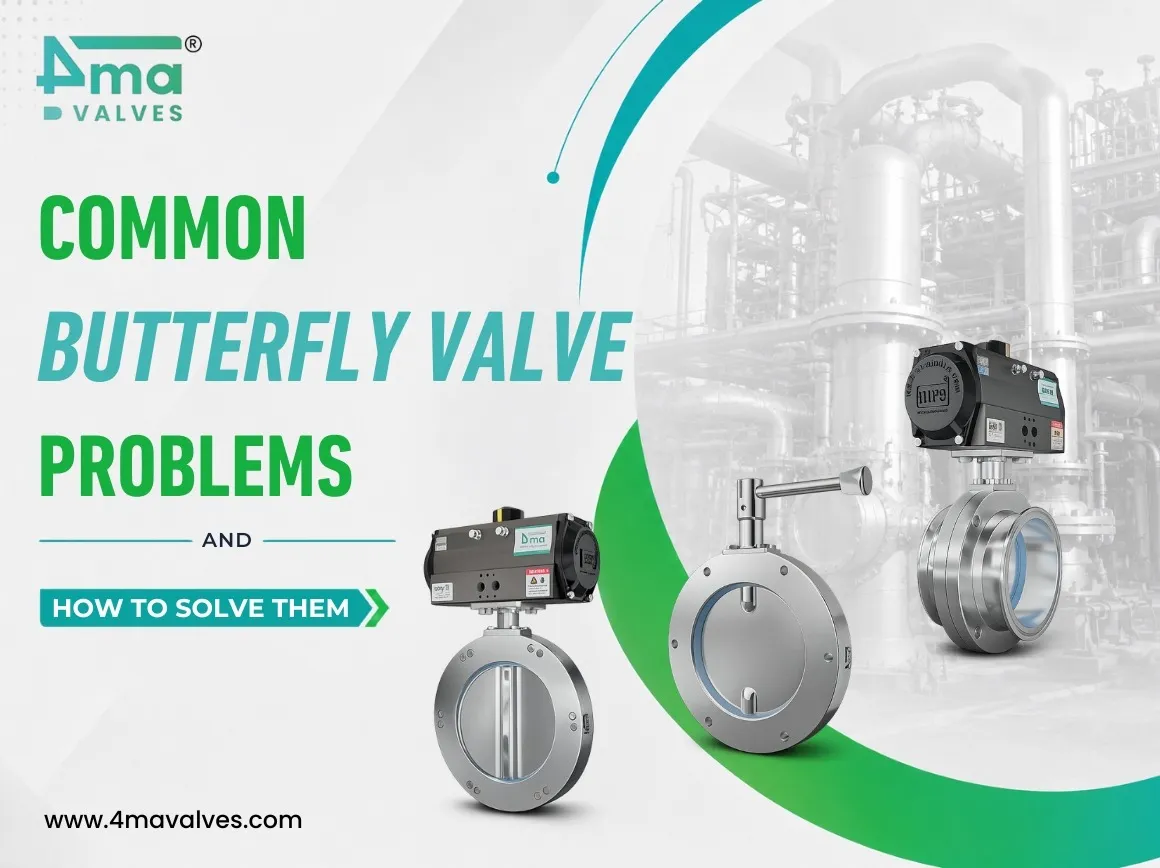
Sanitary butterfly valves are a production workhorse in food, beverage, dairy, and pharmaceutical manufacturing. Their compact design, full-bore flow path, quick quarter-turn operation, and competitive cost make them the natural choice for a wide range of shut-off, isolation, and CIP circuit duties. They are generally robust and reliable — but they are not immune to problems.
When a sanitary butterfly valve develops a problem, the symptoms can range from an obvious external leak to a subtle loss of process control that takes time to trace back to the valve. Knowing the most common failure modes — what causes them, how to identify them, and how to resolve them — is essential knowledge for any maintenance team running hygienic processing lines.
This guide covers the eight most frequently encountered butterfly valve problems in hygienic processing plants, with practical troubleshooting and resolution steps for each.
Problem 1: Seat Leakage — Valve Not Achieving Tight Shut-Off
Symptoms
- Product or cleaning solution is detected downstream of a nominally closed butterfly valve.
- Pressure hold test on the closed valve shows pressure decay.
- Flow meter on the downstream side reads non-zero with the valve closed.
Common Causes
- Seat wear from repeated disc-to-seat contact over a high cycle count.
- Seat swelling or chemical attack caused by incompatibility with process media or CIP chemicals.
- Disc not fully closing due to actuator misalignment, actuator end-stop incorrectly set, or coupling wear between actuator and disc stem.
- Foreign material — scale, product solids, or gasket fragments — lodged between the disc and seat preventing full closure.
Resolution
- Inspect the disc and seat for wear, deformation, or chemical damage — replace the seat if wear is visible.
- Verify actuator end-stop setting and confirm the disc reaches the fully closed position on the actuator travel.
- Check for debris in the seat area — flush the valve and inspect before reassembly.
- Confirm seat material is chemically compatible with the full range of process media and CIP chemicals in use.
Problem 2: External Leakage from the Disc Stem
Symptoms
- Visible product or liquid leaking from the disc stem area on the valve body.
- Staining, corrosion tracks, or product residue on the external valve body around the stem exit point.
- Leakage worsens when the valve is operated or when process pressure increases.
Common Causes
- Stem seal (O-ring or packing) degraded due to age, chemical attack, or excessive thermal cycling.
- Stem corrosion or surface damage preventing the seal from seating correctly.
- Incorrect stem seal material specified for the process media or CIP chemistry.
- Fasteners on the stem seal gland under-torqued during assembly.
Resolution
- Replace stem seals as a first step — this resolves the majority of stem leakage cases.
- Inspect the stem surface for corrosion or scoring — a damaged stem surface will not retain a seal regardless of seal condition.
- Verify that the replacement seal material is appropriate for the application — request FDA 21 CFR compliance documentation from your supplier.
- Source replacement seals from your hygienic valve manufacturer to ensure OEM specification is maintained.
Problem 3: Disc Not Returning to Full Open Position
Symptoms
- Flow rate is lower than expected with the valve nominally open.
- Increased pressure drop across the valve in the open position.
- CIP flow velocity is insufficient despite correct supply pressure.
- Actuator position feedback shows ‘open’ but physical disc position is partially restricted.
Common Causes
- Actuator spring fatigue — spring-return actuators lose return force over time, leaving the disc in a partially open position.
- Pneumatic actuator receiving insufficient air supply pressure to overcome seat friction and fully open the disc.
- Disc or stem binding due to corrosion, product build-up, or deformation at the seat interface.
- Actuator coupling between the actuator drive and disc stem has developed play, causing position lag.
Resolution
- Check air supply pressure at the actuator — verify it matches the actuator’s specified operating pressure.
- Test actuator spring function by disconnecting the air supply and observing the spring return — sluggish or incomplete return indicates spring fatigue and actuator replacement.
- Manually stroke the valve with the actuator disconnected — if the disc is stiff to turn, investigate disc and stem condition before assuming an actuator fault.
- Inspect and replace actuator coupling if play is detected.
Problem 4: Valve Difficult to Operate — High Torque Required
Symptoms
- Manual butterfly valve is stiff or requires excessive force to operate.
- Automated valve shows slow operation, sluggish response, or actuator stall before reaching full stroke.
- Actuator is undersized for the operating conditions encountered in service.
Common Causes
- Seat swelling caused by chemical incompatibility — a swollen seat grips the disc more tightly, dramatically increasing operating torque.
- Process pressure acting against the disc creating differential pressure torque that exceeds the actuator output.
- Product build-up or scale on the disc or seat increasing friction.
- Disc stem corrosion or seizure in the stem bushings.
- Actuator originally sized at process conditions that have since changed — higher operating pressure or temperature than the original specification.
Resolution
- Check seat material compatibility with current CIP chemistry — seat swelling from chemical attack is a definitive sign of material incompatibility.
- Calculate the differential pressure torque at operating conditions and verify the actuator output torque rating is sufficient with an adequate safety factor (typically 1.25–1.5 times the calculated torque).
- Clean or replace the disc and seat to remove build-up.
- Inspect stem bushings for corrosion or seizure — replace if movement is restricted.
Problem 5: Vibration and Noise During Operation
Symptoms
- Audible vibration or chattering when the valve is partially open.
- Vibration transmitted into connected pipework or supporting structure.
- Noise that worsens at certain flow rates — particularly at intermediate disc positions.
Common Causes
- Butterfly valve being used for throttling service — disc flutter at intermediate positions is a characteristic behaviour of butterfly valves used outside their intended on/off duty.
- Cavitation — flow velocity through the partially open disc creates low-pressure zones where the fluid vapourises, causing vibration and disc surface damage.
- Resonance between the valve disc and connected pipework at certain flow conditions.
Resolution
- For throttling applications, replace the butterfly valve with a purpose-designed sanitary control valve that is engineered for modulating service — this resolves disc flutter definitively.
- For cavitation: reduce upstream pressure, increase downstream back pressure, or replace with a valve type rated for the flow conditions.
- For resonance: change the operating point or install vibration dampening on the connected pipework.
Problem 6: CIP Cleaning Not Reaching the Disc Shadow Zone
Symptoms
- Microbiological monitoring results fail on the downstream side of the butterfly valve after CIP.
- Product residue or biological growth visible on the disc edges or seat area after cleaning.
- CIP validation records show inadequate cleaning effectiveness at the butterfly valve location.
Common Causes
- Butterfly valve disc does not fully open during CIP, leaving a shadow zone where cleaning flow is disrupted.
- Disc geometry creates flow turbulence that reduces cleaning velocity on the downstream face of the disc.
- Valve installed in a position or orientation that creates a dead space behind the disc body.
Resolution
- Verify that the valve is programmed to open fully during CIP cycles — check PLC logic and actuator function.
- For butterfly valves where the disc geometry is confirmed to restrict CIP flow, evaluate replacement with a valve type that offers better CIP penetration for the specific installation.
Review the installation design against EHEDG guidelines for hygienic valve installation — orientation and dead leg length are critical factors.
Problem 7: Actuator Position Feedback Errors
Symptoms
- Control system shows the valve as open when it is physically closed, or vice versa.
- Process alarms triggered by position signal errors rather than actual valve faults.
- Intermittent position signal loss causing process control instability.
Common Causes
- Limit switch or proximity sensor displaced from its set position due to vibration or mechanical shock.
- Moisture ingress into the position sensor enclosure causing signal corruption or short circuits.
- Actuator coupling wear causing disc position to lag behind actuator position, making the feedback signal inaccurate.
- Electrical connection corrosion on the sensor cable or terminal block.
Resolution
- Re-set limit switch positions with the disc physically confirmed in the open and closed positions — do not rely on actuator indicator marks alone.
- Inspect sensor enclosures and cable glands for moisture ingress — replace damaged seals and re-torque cable gland fittings.
- Check actuator coupling for play — replace if disc position lags actuator position by more than the acceptable tolerance.
- Inspect all electrical connections for corrosion — clean or replace corroded terminals.
Problem 8: Premature Seat Wear
Symptoms
- Seat replacement intervals are shorter than the manufacturer’s recommendation.
- Seat wear is uneven — heavier wear on one side of the seat than the other.
- Leakage develops rapidly after a recent seat replacement.
Common Causes
- Valve being operated at differential pressures above its rated specification — higher differential pressure increases the force with which the disc contacts the seat on every cycle.
- Disc not aligned correctly with the seat — uneven contact causes accelerated local wear on the high-pressure side.
- Incorrect seat material hardness for the operating conditions — a seat material that is too soft wears faster under the disc contact load.
- Particulates in the process stream scoring the seat surface each time the valve cycles.
Resolution
- Verify operating differential pressure against the valve’s rated specification — if pressure exceeds the rating, a higher-rated valve or a different valve type is required.
- Check disc alignment in the seat and re-centre if uneven wear is detected.
- Review seat material specification with your supplier — a harder or more wear-resistant seat compound may extend service life significantly.
- For process streams containing solids or particulates, assess whether a different valve type is more appropriate for the duty.
Solve Your Butterfly Valve Problems with 4ma Valves Automation
4ma Valves Automation supplies certified sanitary butterfly valves, replacement parts, and technical support for food, beverage, dairy, and pharmaceutical processing. Whether you are troubleshooting an existing valve problem or specifying new equipment, our team can help you find the right solution.
Contact us today: https://4mavalves.com/contact
Conclusion
Sanitary butterfly valves are reliable workhorses in hygienic processing — but like all mechanical components, they develop problems when they are incorrectly specified, poorly maintained, or pushed beyond their design limits. The eight problems covered in this guide represent the most common issues maintenance teams encounter, and in most cases the resolution is straightforward once the root cause is correctly identified.
The key is systematic troubleshooting — starting from the symptoms, working back to the cause, and addressing the underlying issue rather than just replacing parts. Combined with a structured maintenance programme and a reliable hygienic valve supplier, this approach keeps butterfly valves performing reliably across their full service life.
Frequently Asked Questions
Why is my sanitary butterfly valve leaking after a recent seat replacement?
Leakage after a seat replacement is commonly caused by an incorrectly installed seat, a seat material that is incompatible with the process media or CIP cleaning chemicals, or disc misalignment preventing proper sealing. Verify that the disc closes completely against the actuator end-stop, inspect the seat for correct installation, and confirm the seat material is suitable for your application.
Can butterfly valves be used for flow control in food processing lines?
Butterfly valves are primarily designed for full open or full closed operation and are not recommended for continuous throttling. Using them for flow control can lead to disc flutter, accelerated seat wear, and cavitation under certain operating conditions. For accurate flow modulation in hygienic applications, a sanitary control valve is the preferred choice.
What causes a butterfly valve disc to vibrate during operation?
Disc vibration is most often caused by operating the butterfly valve in a partially open position for throttling service. Additional causes include cavitation under high differential pressure and vibration or resonance from connected pipework. Operating the valve fully open or fully closed, or replacing it with a control valve for throttling applications, is typically the best solution.